↓ Jacob Collier Transcription ↓
This blog post is a supplement to the video I made about the Harpejji Notation System. Go watch that if you haven’t, I go through a lot of helpful examples and explanations. If you have any questions or ideas please get in touch with me on my contact me page!
What are we really trying to do here?
We are trying to tell a Harpejjist exactly where to play each note on the fretboard through the course of any written music. If it ain’t broke, don’t fix it; we will use regular western music notation to write the actual music. This means we need a system that latches onto regular music notation to provide Harpejji specific positional information.
(X,Y) Coordinate Plane
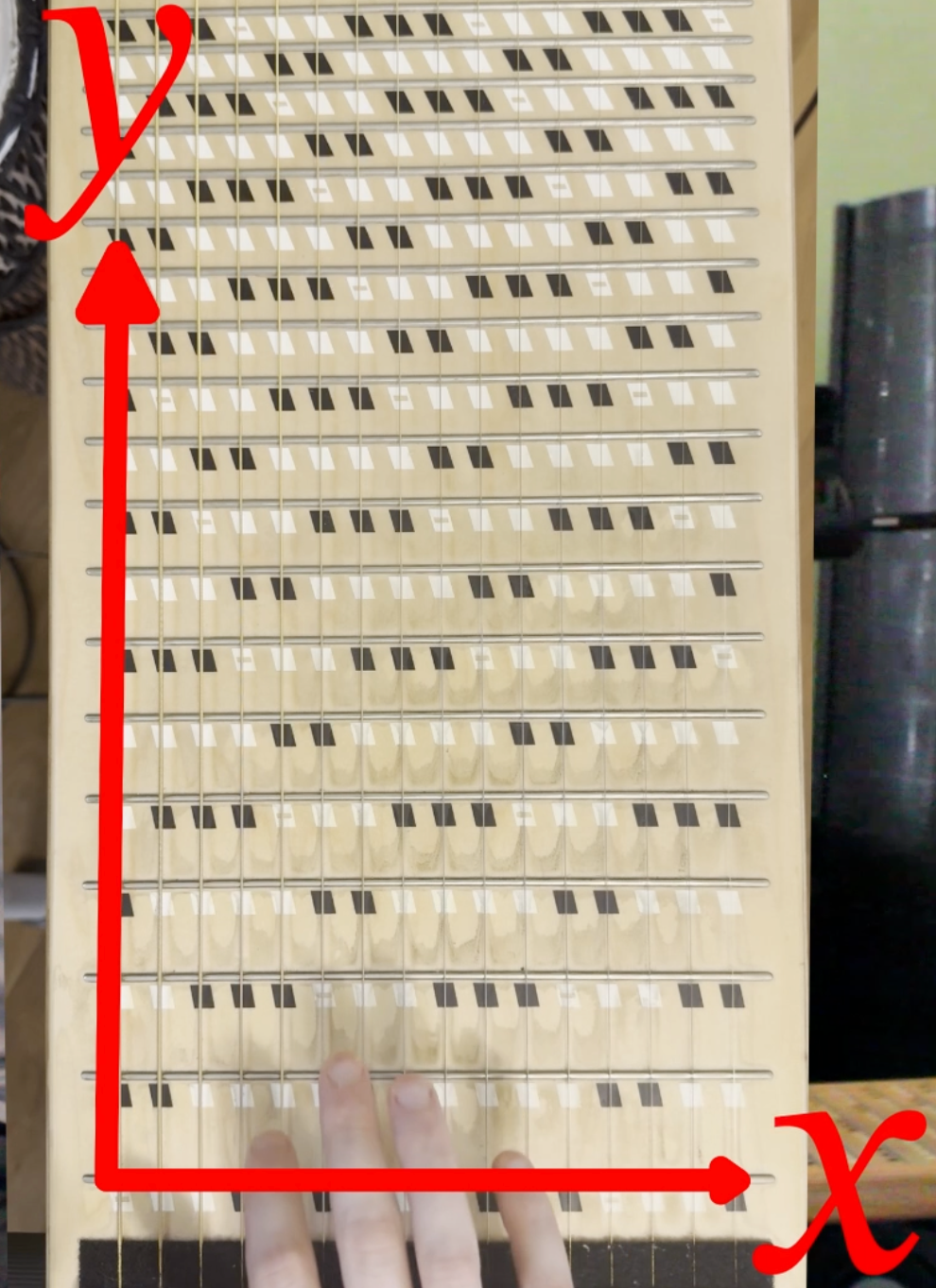
The Harpejji is a musical grid with a consistently repeating note pattern. Creating an X,Y coordinate plane is a logical first step towards developing our system. The X axis represents the strings, and the Y axis represents the frets.
Any position you can play on the Harpejji can now be represented with a coordinate. You can’t write music like this but it’s the fundamental logic behind the Harpejji notation system.
We need to change how we refer to the X and Y axis to create a useful system.
Redefining Y Axis
Instead of using fret numbers to define the Y axis, we can use notes. On any one string, a note can only be played in one place. Notes on one string never repeat. We can rely on regular music notation to provide the notes. As long as we know which string we are supposed to be playing, a note provides the Y axis position on the fretboard.
String Labels and String Position Modifiers (Redefining X Axis)
We got rid of the frets on the Y axis, but we still need a way to manage 16(+) strings. We will label the strings off of the lowest frets note values, ignoring accidentals. These are called String Labels.
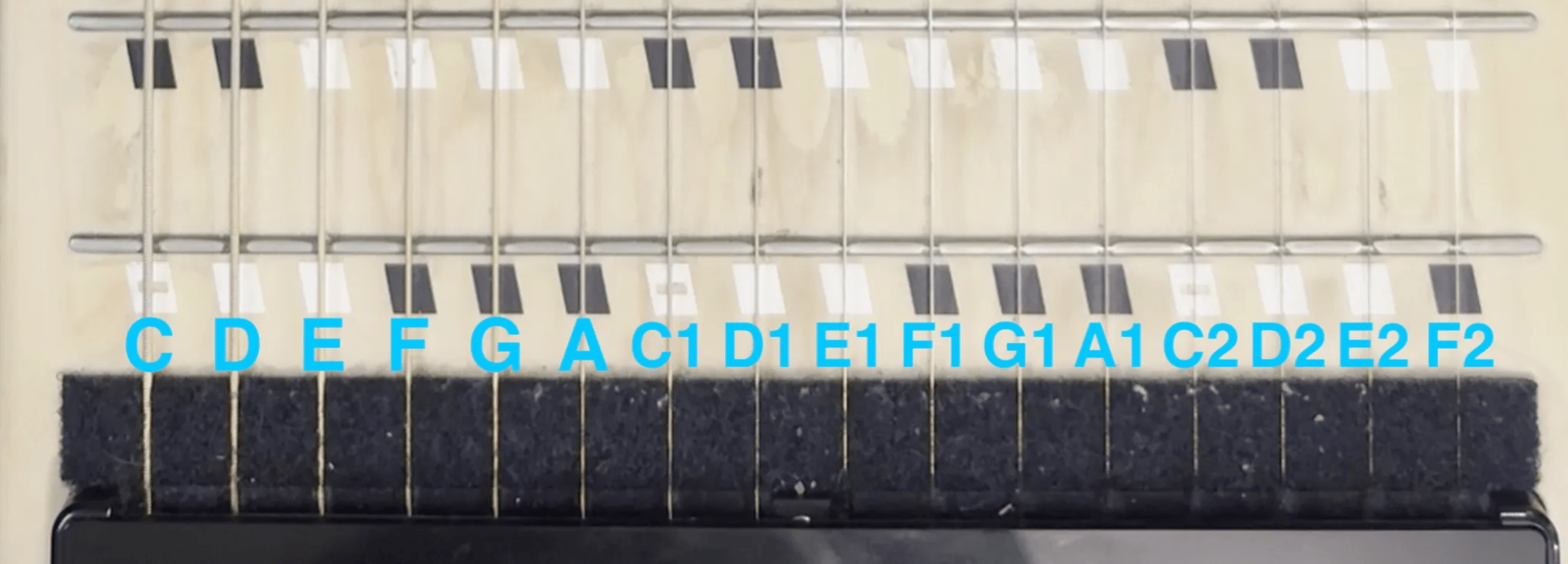
At the beginning of the music, we will tell the player which string to start on by writing a string label. After that, we use a referential system to determine string position.

The symbols above are called String Position Modifiers. They are arrows placed next to notes that tell you to move up or down strings as you play through music. Each dot means to skip a string. Two dots mean skip two strings. After 3 dots, start using numbers to show skips. Don’t go past ~6 string skips, it becomes too annoying to read. We have other ways to establish string position in those cases.
Symbolic Representation of the Fretboard
The greatest strength of this system lies in it’s ability to abstract the fretboard into symbolic representation. This is a step above pictographic representations such as a tablature systems. The interval between two notes being played, combined with a string position modifier, produces a “shape” on the fretboard. For example, ascending a major second while moving up one string will always be right next to the first note. An ascending minor third up one string will always be one diagonal from the starting note. As you vary the intervals and string position modifiers, the resultant shapes spindle outwards like chess moves. Combinations of intervals and string position modifiers always produce the same shape, independent of the starting string. This reveals the symmetry of the harpejji’s isomorphic layout.
Marry had a little Lamb
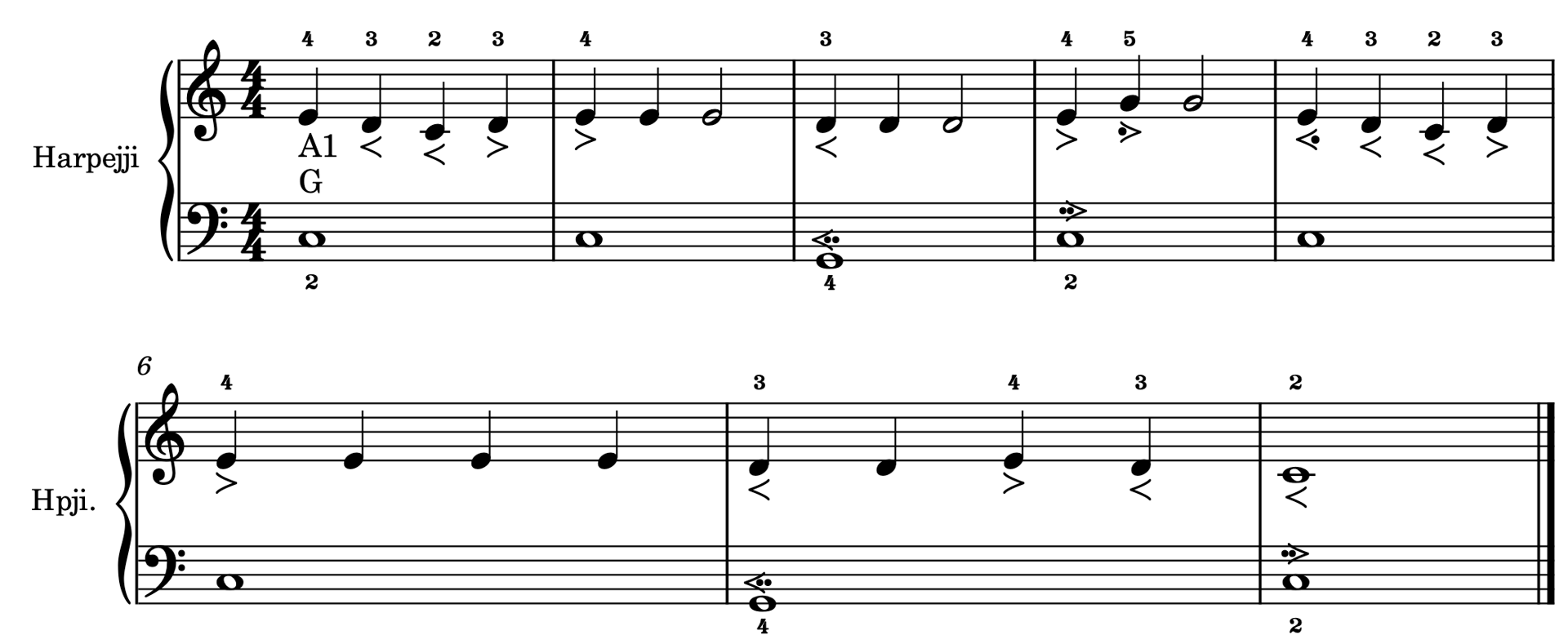
Here is a simple example to show how string labels, string position modifiers and written music work together. Note that we are using piano fingering numbers for Harpejji.
String Memory
In the second measure of the example above, where there is no string position modifier or fingering changes and you’re playing the same note, it’s safe to assume that you play those notes on the same string with the same finger. String memory is simply giving that a formal name. You can logically expand this principle into these rules:
If there is no string position change, play the note(s) on the same string. If there's no fingering change, play the note(s) with the same finger. Therefore, if there is neither, play the note(s) on the same string with the same finger.
Reference Strings
As you read through music, you change the strings you are playing based on string position modifiers. String position modifiers need to look back at a string to know where to start from. The string that a string position modifier looks back at to base its movement is called a reference string. In monophonic music, the reference string will always be the string set by the previous string position modifier.
In the Marry had a little Lamb example, this concept is self evident and doesn’t need an explanation. As music increases in complexity and we introduce chords, it’s important to define the concept of a reference string. Again, the reference string is the string that a string position modifier looks back at to determine starting position for the change in strings. I swear it’s less complicated than writing it out makes it sound.
Chords - Slashed and Voiced Notation
In the Harpejji notation system, there are two different ways to notate chords: slashed and voiced notation. In theory, you can write any chord with either method. Certain musical ideas lend themselves more to one method over the other. Luckily, if one method is cumbersome for a particular chord or phrase, usually the other method is better suited.
Slashed Notation
In slashed notation, a slash is used to denote a dominant reference string. A dominant reference string is the reference string when there are multiple strings being played at once. String position modifiers are placed on the other notes of the chord. The string position modifiers reference each other moving outward from the slash. The slashed note is played on the relevant reference string or string label. Therefore, in the example below, the “A” string label is assigned to the slashed note in the chord; the C note is played on the A string. Then, the E is 1 string above the C, the G is 1 string above the E and the B is a string skip above the G.
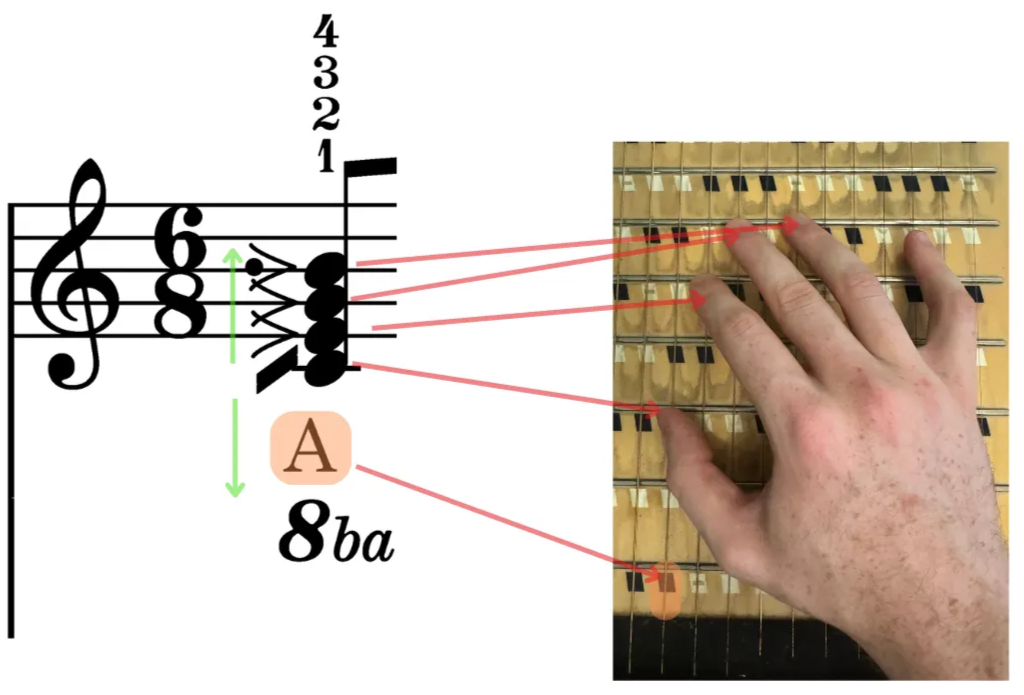
Slashed chords are anchored in space by the slash. The chord shape is defined by the string position modifiers on the other notes spanning outwards. To move between slashed chords, we need to be able to move the slashed note’s string position. We do this by placing string position modifiers before the slash. Now we can move the slashed note’s string around in the same way as monophonic writing.
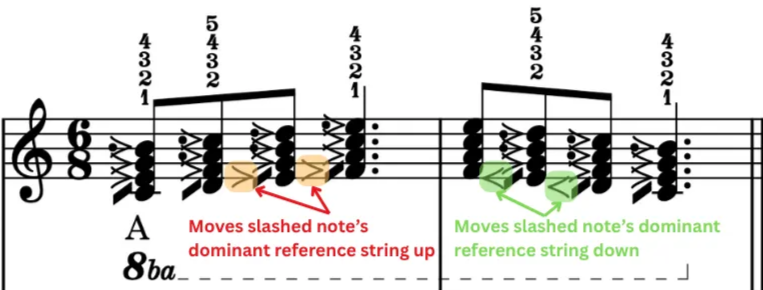
The same principles discussed under Symbolic Representation of the Fretboard apply to chord shapes. Chords with identical intervalic structure (the same voicing), when combined with the same layout of string position modifiers, create the same shape on the fretboard. Note that the string position modifiers used to move the dominant reference string don’t affect the chord shape.
Since the first and fourth chords in this example are both major 7 block chords with the same string position modifier layout, their shapes on the fretboard are the same. Same thing applies to the second and third minor 7 block chords.
Voiced Chord Notation (Non Slashed)
In voiced chord notation, each note (voice) in the chord gets its own set of string position modifiers and reference strings. That means each voice in the chord looks back at the previous string position modifier specific to that voice to determine future string movement.
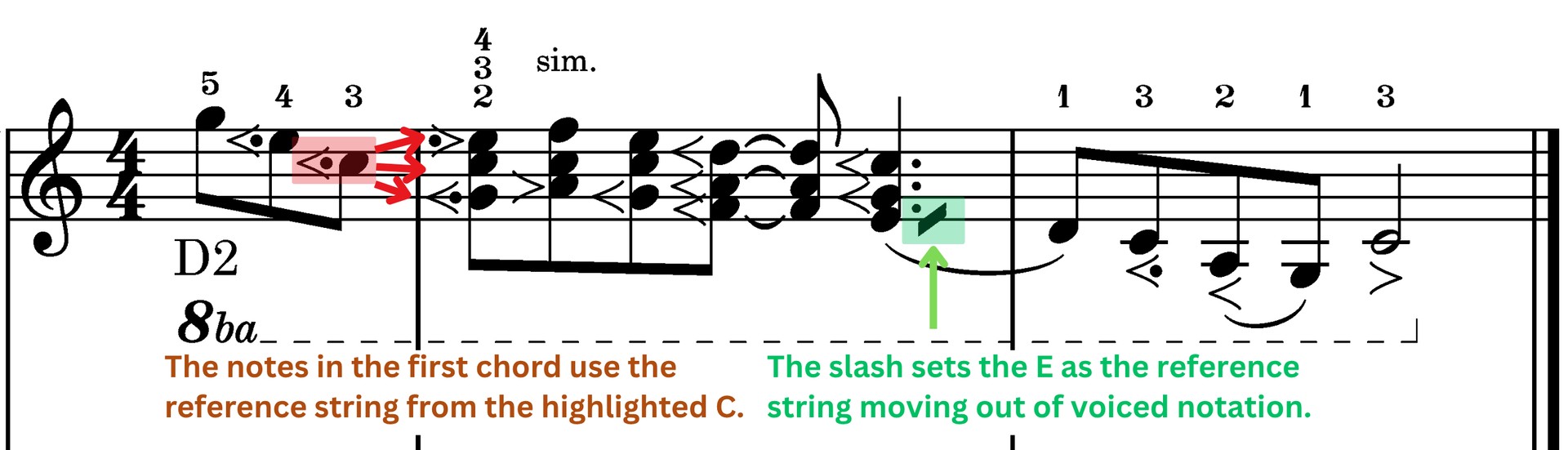
The example above shows getting into and out of voiced notation. When moving from monophonic writing to polyphonic, the reference string set at the end of the monophonic section is used by all the voices in the first appearance of polyphony. In this example, the string played for the monophonic C becomes the reference string for all 3 notes in the second inversion C chord. Moving on, each voice in the chord has it’s own set of string position modifiers and reference strings.
To exit voiced notation, a slash is placed after the note that you want to establish as the reference string for the next section of music. This is highlighted in green above.
Reference Slashes
Reference slashes are used to recall previously played strings.
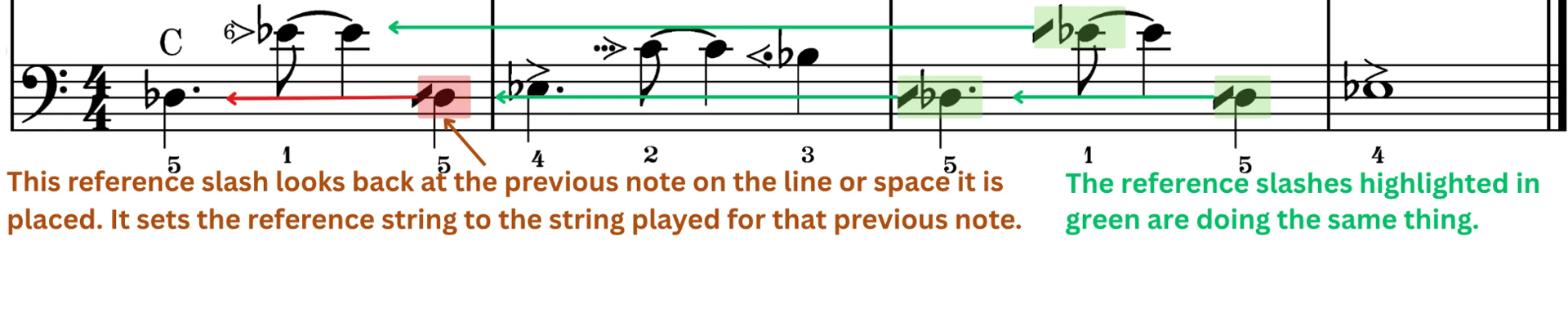
Reference slashes are vertically based, meaning they look back to the most recently played note on the staff line or space they are placed. They then set the reference string back to the string used to play that note. You can place a string position modifier after the slash to move the string position further if necessary. Below is an example of this applied in the left hand.
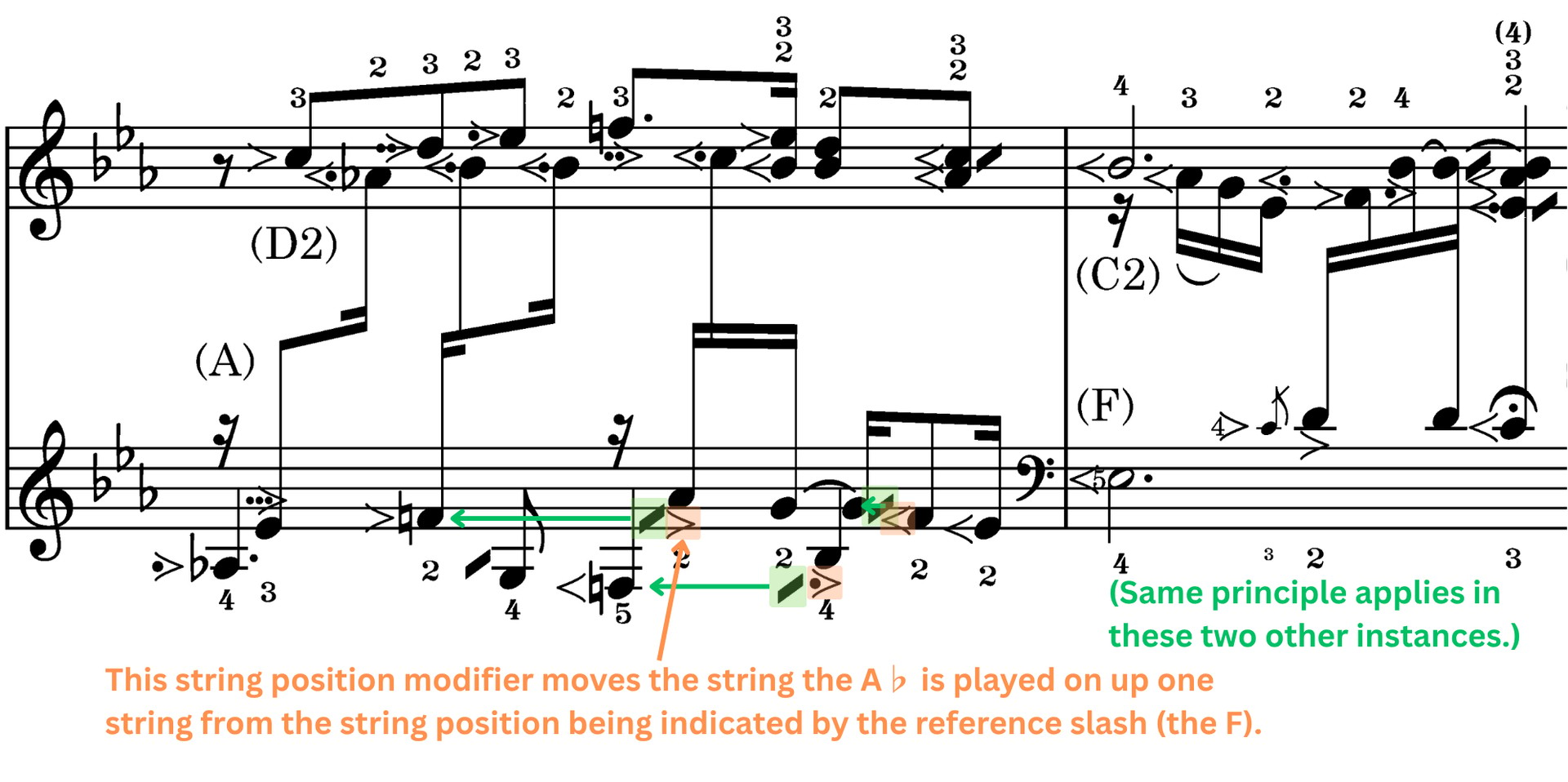
Reference slashes make it easier to juggle different voices being played in one hand that have large jumps in string positions.
Playing Techniques
There are many unique ways to play the Harpejji. Slides (glisses), strumming, bends, hammer ons, pulloffs, harmonics and many other cool techniques add depth to the instrument. It is important to be able to notate these techniques so players can share ideas. I covered some of these in the youtube video. I’ll write more later.
Thanks for reading!